Archive | The Day Magic Died RSS feed for this section

The language of magic — part 2 of lots

4 Oct

Inamali is the language of magic – the language of the Inamali people and their writings, including their spell books. It is the language Karia must master if she is to understand how to destroy magic.

And I thought you may enjoy the books a lot more if you understand a few things about the Inamali language.

Spoiler alert: If you have not read The House in the Old Wood, you will not want to read the rest of this post.

With so few ways to make syllables, leading to a total of 37 possible syllables, many Inamali words look and sound alike. Is this confusing?

Possibly, but think about this: Have you ever heard someone use to, two or too in a conversation? Of course you have. Now, how many times were you confused over whether it was a preposition, a number or a synonym for also? Even once?

Why were you not confused? Context.

So let’s look at a sentence using our Inamali example: the word sili, which can mean playful, redfish, cumulonimbus or walk slowly. If I were to write, Tsikalitar’uluva Karia sili, or actually,
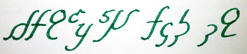
Tsikalitar’uluva Karia sili

you would know, if you spoke and read Inamali, that the first word is a verb, the second is the subject and the third is the object. So just from basic grammar you would know that in this case, sili must be a noun, so it could not mean playful or walk slowly. It has to mean redfish or cumulonimbus.

Now, if you strip away all the modifiers from the verb, you would see tsiva – to fish. We’ll talk about how that works when we talk about “heavily modified verbs” later on. For now, let’s keep our focus on sili. We have “Karia fished sili.” Let’s see now, what makes sense here? Did she go fishing for redfish or clouds? Hmmm. Let me think …

Someone who spoke Inamali would not be puzzled at all by that.

That’s not to say confusion isn’t possible. It happens. But we can usually work out what someone is saying. For instance, if I showed you a photo of a field full of purple flowers, and you heard me say, “Look at all the flocks,” you would probably look for bunches of birds in the photo. But seeing none, you would likely soon figure out I had actually said, “Look at all the phlox.”

This same type of “difficulty” exists in written Chinese, where the same character can mean different things, depending on the context. And it doesn’t seem to be keeping the Chinese from doing just about anything.

Next time we’ll take a look how a syllabary influences the way an Inamali speaker thinks about words and sounds.

Want free bookmarks?

3 Oct

BookmarkI’ve just had bookmarks made, and I’d be glad to give or send some to you, as a thank-you for reading my books. (The picture above shows both sides of one bookmark.)

Yes, they’re free, but there’s a catch. Notice I said, “I’d be glad to give or send some to you.” The least you will get is five. You can keep one, but I want you give the other four away to friends, and to encourage them to read the books too.

I’ve already had one person tell me, “But I don’t have four friends.” Then these bookmarks are perfect for you. Giving a stranger a bookmark may just start you on the road to another friendship.

If you want more than five, that’s great too. Just keep one as my thanks to you for reading my the books, and give the others away.

Send a message through the page on Facebook, or use the contact form here.

This offer is good until I run out of bookmarks.

The language of magic, part 1 of lots

2 Oct


Inamali is the language of magic – the language of the Inamali people and their writings, including their spell books. It is the language Karia must master if she is to understand how to destroy magic.

And I thought you may enjoy the books a lot more if you understand a few things about the Inamali language.

Spoiler alert: If you have not read The House in the Old Wood, you will not want to read the rest of this post.

A syllabary

In The House in the Old Wood, Karia discovers that Inamali is not written letter by letter, but syllable by syllable. I’ve mentioned before that systems of writing syllable by syllable are called syllabaries.

English could not be efficiently written with a syllabary because there are so many possible syllables in English. Put together just about any two or three letters – or even four or five or more – and it’s likely to be a syllable you can find in at least one of our English words. We have a lot of words. The Oxford English Dictionary puts the number around 250,000, while some say it’s passed 1 million.

That’s a lot more than virtually any other language.

Far fewer syllables

But it’s not just the number of words that makes a difference. It’s the types of syllables. English has open syllables (syllables that end in vowels) and closed syllables (those that end in consonants). Many languages – such as Inamali – have only open syllables. This means there are far fewer possible syllables, and therefore Inamali can be written with a syllabary.

The possible number of Inamali syllables is further limited by the small number of consonants and vowels. Twenty consonants and three vowels, actually, arranged in 37 syllables.

Leads to some words being the same

With fewer syllables to work with, a lot different Inamali words look and sound like the same word. So, sili means playful and redfish and cumulonimbus and walk slowly – four completely different concepts, expressed with the same two symbols and sounding exactly alike:

sili

So how would you tell them apart? How could you ever make sense out of what someone was saying?

Easily, actually.

We’ll take a look at that next time …

Paperback of Karia’s Path now available!

29 Sep

Karia's PathYou can now order the paperback version of Karia’s Path, Book Two of The Day Magic Died, from Amazon.com

Just like the second edition of The House in the Old Wood, the list price is $10,99. And both books are usually available for less from Amazon.

Thanks for your help!

28 Sep

Wow, thank you for your response to my requests that you invite people to the Facebook page for The Day Magic Died by Ian Fallis. We are now only 9,922 short of 10,000 “Likes”!

Hmm.

Maybe I’d better lower my expectations. We have 78 “Likes” – can you help us get to 100?

If you didn’t already invite your friends to like the page – or you’re a new fan – could I please ask you to do so now? Here’s how:

  • Go to the page: The Day Magic Died by Ian Fallis
  • Look just below the page banner on the right. You’ll see a listing of your friends who like the page, and just below that, a list of friends you can invite.
  • Invite your friends! You can pick and choose, or you can click on friend after friend.

Please – invite away!

Here are more free and simple ways you can help. Go to The Day Magic Died on Facebook and:

  • Check out the latest posts and find one you like, then “Like” it.
  • Find one you’d like to share with your friends, and “Share” it.
  • Join a conversation about a post by commenting on it.
  • Post your own comment or question – I’d be glad to reply.
  • And make sure you keep an eye out for new posts in the coming days and weeks — like, announcements for the paperback version of Karia’s Path and the release of Book Three, The Hall of the Prophetess, and one more …

Thanks!