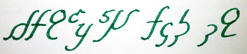
The language of magic, part 3 of lots

7 Oct

Inamali is the language of magic – the language of the Inamali people and their writings, including their spell books. It is the language Karia must master if she is to understand how to destroy magic.

And I thought you may enjoy the books a lot more if you understand a few things about the Inamali language.

Spoiler alert: If you have not read The House in the Old Wood, you will not want to read the rest of this post.

OK, English speaker, whose language is written with an alphabet. What’s the relationship between the following syllables: a, ka, ma, sa, va?

They all have the same vowel, right?

Well done.

But what’s the relationship between the following symbols?

a, ka, ma, sa, va

Those are a, ka, ma, sa and va in Inamali. And someone who spoke Inamali would see no more relationship between them than you see in the symbols.

An Inamali speaker is not thinking in terms of the sounds individual letters make, because their language has no individual letters. They’re not thinking, “Oh, those all end in ‘a,’” because a is a distinct and different syllable from ka.

But knowing that, if you were to peruse an Inamali syllabary, you would see something strange. Some of the symbols for syllables with the same vowel are similar.

For instance, here are a, la, ra and sha:

a, la, ra, sha

Why the similarities?

Inamali arose among people who spoke and wrote the language commonly known as Teneka – the language of all people, based on the language of Nymph, written with an alphabet. Inamali is based on the language of Sylph.

It bears similarities to Analiki, which was the previous language of magic, and also arose among people who spoke and read Teneka and also is based on the language of Sylph.

So the influence of an alphabet shows up in both Analiki and Inamali.

Next we’ll look at the stuff that really doesn’t make sense.

Good reviews needed

5 Oct

Now that Book 2, Karia’s Path, is out, it’s in need of good reviews.

Whoops, let me clarify. I don’t mean I’m asking for five-star raving reviews. Those are nice, but even a critical one-star review can be a good review.

A good review is useful, pertinent and honest.

A useful review gives potential buyers information that helps them evaluate whether this is or is not a good purchase for them.

So you might compare and contrast the book with similar books in the genre, or with the first book, The House in the Old Wood. You could tell them what you liked or didn’t like (without spoilers, please). You may wish to mention whether you found it engrossing or captivating; whether you learned anything; how it made you feel; and if you plan to keep reading the series.

A pertinent review pertains to the book in question. A review of Karia’s Path shouldn’t dwell on The House in the Old Wood, though you might mention it since they’re in the same series. It shouldn’t be a personal statement about the author, such as “He’s a really nice guy” or “Never trust an author with a beard.”

But it could be about the packaging. If your paperback had problems, or you thought the formatting for the Kindle was awesome, say so.

An honest review means just that. Tell the truth. No one is served by an overly glowing review. And a deliberately and dishonestly nasty review is just, well, nasty. Say what you mean. You don’t need to sugarcoat it.

Feel free to post a mixed review. I often find mixed reviews are the most helpful kind, because they give me the opportunity to decide based on how important the factors cited are to me.

And thank you. Thank you for reading the books, and an extra thanks to those who post reviews.

Don’t have Karia’s Path yet? Get it!

The language of magic — part 2 of lots

4 Oct

Inamali is the language of magic – the language of the Inamali people and their writings, including their spell books. It is the language Karia must master if she is to understand how to destroy magic.

And I thought you may enjoy the books a lot more if you understand a few things about the Inamali language.

Spoiler alert: If you have not read The House in the Old Wood, you will not want to read the rest of this post.

With so few ways to make syllables, leading to a total of 37 possible syllables, many Inamali words look and sound alike. Is this confusing?

Possibly, but think about this: Have you ever heard someone use to, two or too in a conversation? Of course you have. Now, how many times were you confused over whether it was a preposition, a number or a synonym for also? Even once?

Why were you not confused? Context.

So let’s look at a sentence using our Inamali example: the word sili, which can mean playful, redfish, cumulonimbus or walk slowly. If I were to write, Tsikalitar’uluva Karia sili, or actually,

Tsikalitar’uluva Karia sili

you would know, if you spoke and read Inamali, that the first word is a verb, the second is the subject and the third is the object. So just from basic grammar you would know that in this case, sili must be a noun, so it could not mean playful or walk slowly. It has to mean redfish or cumulonimbus.

Now, if you strip away all the modifiers from the verb, you would see tsiva – to fish. We’ll talk about how that works when we talk about “heavily modified verbs” later on. For now, let’s keep our focus on sili. We have “Karia fished sili.” Let’s see now, what makes sense here? Did she go fishing for redfish or clouds? Hmmm. Let me think …

Someone who spoke Inamali would not be puzzled at all by that.

That’s not to say confusion isn’t possible. It happens. But we can usually work out what someone is saying. For instance, if I showed you a photo of a field full of purple flowers, and you heard me say, “Look at all the flocks,” you would probably look for bunches of birds in the photo. But seeing none, you would likely soon figure out I had actually said, “Look at all the phlox.”

This same type of “difficulty” exists in written Chinese, where the same character can mean different things, depending on the context. And it doesn’t seem to be keeping the Chinese from doing just about anything.

Next time we’ll take a look how a syllabary influences the way an Inamali speaker thinks about words and sounds.

Want free bookmarks?

3 Oct

BookmarkI’ve just had bookmarks made, and I’d be glad to give or send some to you, as a thank-you for reading my books. (The picture above shows both sides of one bookmark.)

Yes, they’re free, but there’s a catch. Notice I said, “I’d be glad to give or send some to you.” The least you will get is five. You can keep one, but I want you give the other four away to friends, and to encourage them to read the books too.

I’ve already had one person tell me, “But I don’t have four friends.” Then these bookmarks are perfect for you. Giving a stranger a bookmark may just start you on the road to another friendship.

If you want more than five, that’s great too. Just keep one as my thanks to you for reading my the books, and give the others away.

Send a message through the page on Facebook, or use the contact form here.

This offer is good until I run out of bookmarks.

The language of magic, part 1 of lots

2 Oct


Inamali is the language of magic – the language of the Inamali people and their writings, including their spell books. It is the language Karia must master if she is to understand how to destroy magic.

And I thought you may enjoy the books a lot more if you understand a few things about the Inamali language.

Spoiler alert: If you have not read The House in the Old Wood, you will not want to read the rest of this post.

A syllabary

In The House in the Old Wood, Karia discovers that Inamali is not written letter by letter, but syllable by syllable. I’ve mentioned before that systems of writing syllable by syllable are called syllabaries.

English could not be efficiently written with a syllabary because there are so many possible syllables in English. Put together just about any two or three letters – or even four or five or more – and it’s likely to be a syllable you can find in at least one of our English words. We have a lot of words. The Oxford English Dictionary puts the number around 250,000, while some say it’s passed 1 million.

That’s a lot more than virtually any other language.

Far fewer syllables

But it’s not just the number of words that makes a difference. It’s the types of syllables. English has open syllables (syllables that end in vowels) and closed syllables (those that end in consonants). Many languages – such as Inamali – have only open syllables. This means there are far fewer possible syllables, and therefore Inamali can be written with a syllabary.

The possible number of Inamali syllables is further limited by the small number of consonants and vowels. Twenty consonants and three vowels, actually, arranged in 37 syllables.

Leads to some words being the same

With fewer syllables to work with, a lot different Inamali words look and sound like the same word. So, sili means playful and redfish and cumulonimbus and walk slowly – four completely different concepts, expressed with the same two symbols and sounding exactly alike:

sili

So how would you tell them apart? How could you ever make sense out of what someone was saying?

Easily, actually.

We’ll take a look at that next time …